If you are looking to apply for a family-based green card, the questions and guidelines below will help you understand if you qualify.
Jump to...
Relationship Eligibility
Are you applying through a family relationship? If your answer is yes, you are in the right place. Some relationships are not eligible for a family-based green card, however. Use the table below to determine if you can apply for one based on your specific case.
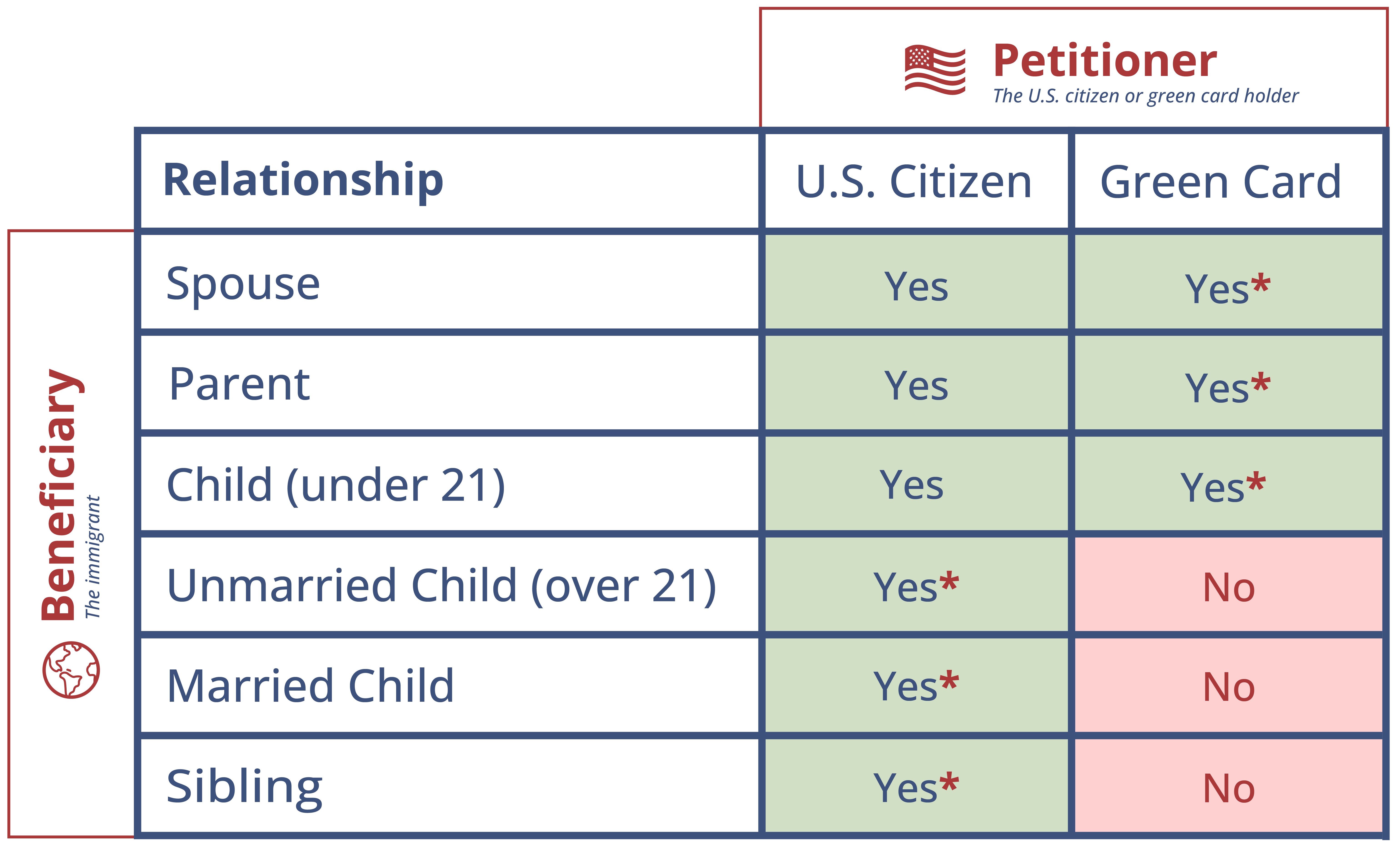
* Family Preference Category (subject to waiting list)
Who Qualifies As a Child?
"Child" includes certain stepchildren and adopted children, but strict rules apply (especially timing and legal relationship requirements).
Upgrading Your Petition
If a green card holder becomes a U.S. citizen, their petition can often be upgraded, which can speed things up.
What is a Family Preference Category?
A family preference category is a type of family-based green card that is subject to annual limits set by U.S. law. Because only a fixed number of visas are available each year in these categories, applicants are placed on a waiting list after their application is filed. Their place in line is determined by their priority date (the filing date of the application), and they must wait until that date becomes "current" in the U.S. Department of State's monthly Visa Bulletin before they can move forward with getting a green card.
Family Preference Categories by Petitioner Status
For U.S. Citizens
- F1 - Unmarried children
21 or older - F3 - Married children
any age - F4 - Siblings
petitioner must be 21+
For Green Card Holders
- F2A - Spouse and unmarried children
under 21 - F2B - Unmarried children
21 or older
You can view the most recent Visa Bulletin to check your preference category status here:
Visa BulletinThings That Could Affect Your Case
It would be a good idea to consult an immigration attorney if any of these describe your case. You can find low-cost or free legal help here:
Even if you check all the boxes already mentioned, you may run into issues if:
- You entered the U.S. without inspection (for Adjustment of Status cases only)
- You have certain criminal history
- You have overstayed or violated a visa
- You have had prior immigration issues or denials
If any of these apply, your case may still be possible, but you may need extra steps. You can learn more about "inadmissibility" and what you can do about it here:
Jump to...
Inside the U.S.
Adjustment of Status
Adjustment of Status (AOS), is the process of applying for a green card from inside the United States. This option is usually available to people who are already in the U.S. and qualify to apply without leaving the country.
With AOS, you submit your application to USCIS, attend a biometrics appointment, and may attend an interview before receiving your green card. In many cases, you can stay in the U.S. while your application is pending and apply for a work permit and travel authorization during the process.
Pros
- Stay in the United States during the process
- May apply for work and travel permits while waiting for a decision
- Family members can often remain together in the U.S. during processing
Cons
- Government filing fees are often higher
- Travel outside the U.S. is restricted until travel authorization is approved
- Interviews and requests for additional evidence can cause delays
Outside the U.S.
Consular Processing
Consular processing is the process of applying for an immigrant visa through a U.S. embassy or consulate outside the United States. This option is commonly used when the immigrant lives abroad or is not eligible to apply for a green card inside the U.S.
With consular processing, the case is first approved by USCIS and then transferred to the National Visa Center (NVC) and a U.S. embassy or consulate for an interview. Once the immigrant visa is approved, the person enters the United States as a lawful permanent resident and receives their green card afterward.
Pros
- May have lower overall government filing fees
- No need to wait inside the U.S. during processing
- Immigrant becomes a permanent resident immediately upon entering the U.S.
Cons
- Requires attending an interview at a U.S. embassy or consulate abroad
- Delays can happen due to administrative processing or embassy backlogs
- No U.S. work authorization during the process
- International travel costs and scheduling can add stress and expense
The Comparison
Can I Switch Between Pathways?
Technically, yes. However, this depends heavily on eligibility and circumstances. Victor (the inspiration for this website) moved from consular processing to AOS, but had the help of an immigration lawyer to ensure he wasn't doing anything he wasn't allowed to do. If you are considering switching from one pathway to another, it is highly recommended to find an immigration attorney to help you through that process.
Below is a very general view of the steps you will take on each pathway, assuming your application is successful. Note that some steps are in a different order depending on which you choose, and that there are some things that you will have to do on one path that you wouldn't have to do on the other.
Adjustment of Status
-
1Medical Exam
-
2File I-130, I-485, I-865, and I-693
-
3Biometrics Appointment
-
4Interview
-
5Case Approval and Green Card Sent
Consular Processing
-
1File I-130
-
2I-130 Approval, Case Moved to National Visa Center (NVC)
-
3File DS-260 and I-865, Pay Immigrant Fee
-
4Medical Exam
-
5Interview
-
6Case Approval and Immigrant Visa Issued
-
7Enter U.S. and Green Card Sent
It is impossible to estimate with 100% accuracy how long your process will take, since each case is different. You can do your part in ensuring there are no avoidable delays by reviewing your application many times before submitting and correcting any errors or adding any forgotten elements.
If you would like a rough guess, USCIS has a tool online that will estimate your total processing time, which can be viewed here:
USCIS Wait Time EstimatorKeep in mind that if you are looking at a wait time for an I-130 approval and you have chosen the consular processing pathway, that is only the estimated time it will take USCIS to approve your I-130. You will still have waiting periods after when you submit your additional paperwork and are waiting for a visa.
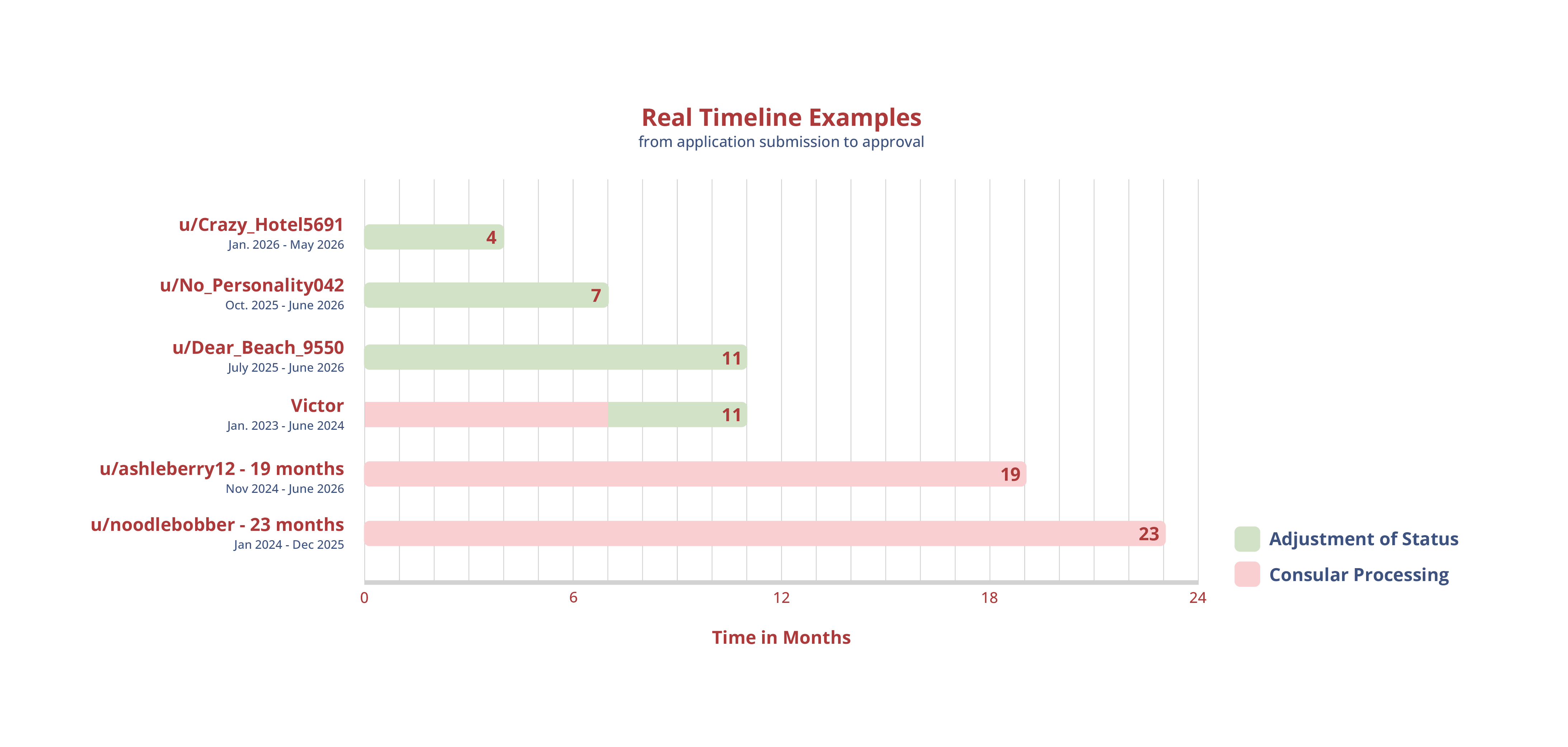
Below, you will find timelines that are based on real experiences shared by applicants. Every case is different, so they cannot help you predict exactly how long your case will take. However, knowing how long it took others to make their way through the system may help you feel more at ease about your own situation.
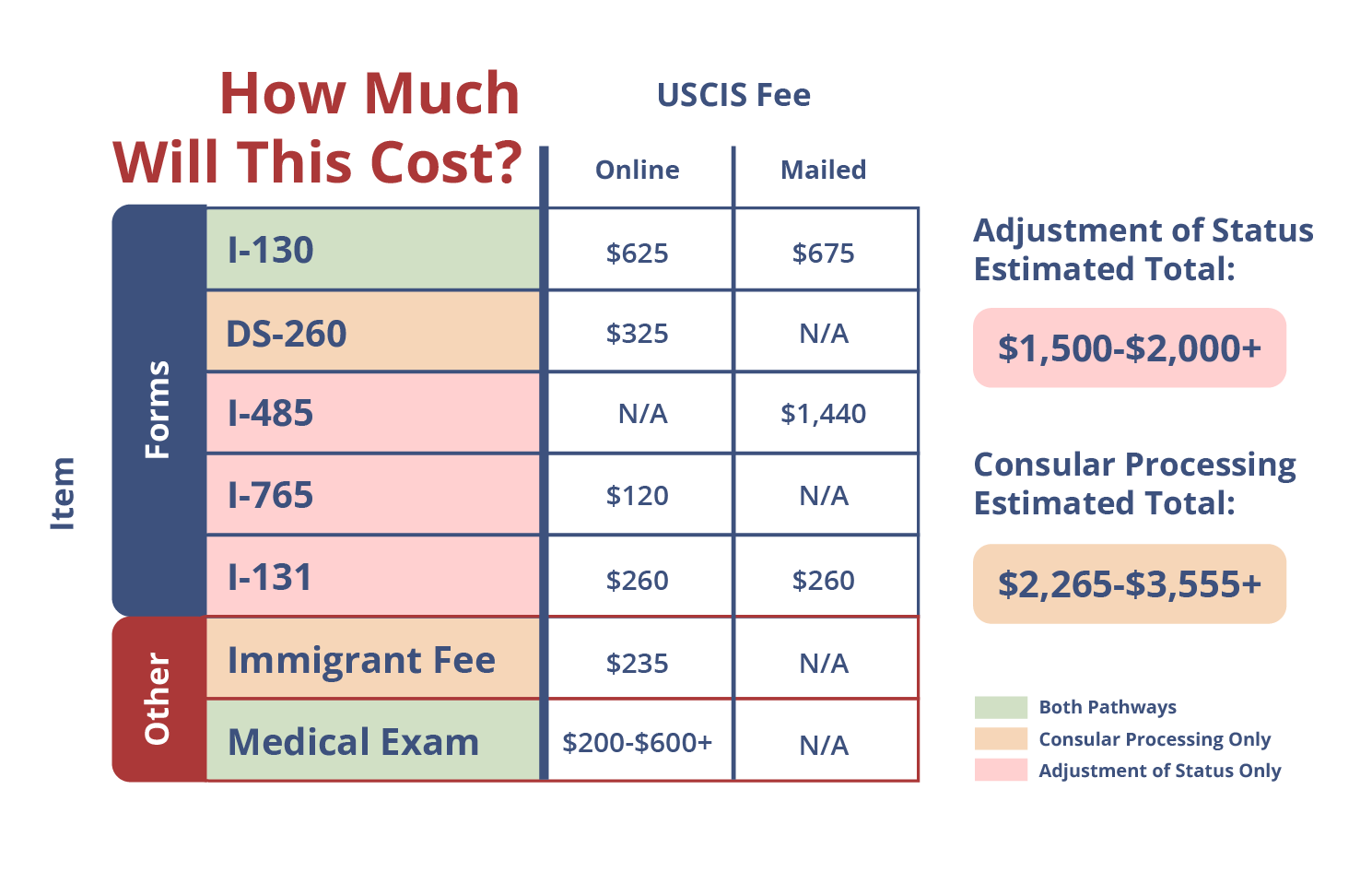
Cost will vary depending on what pathway you choose, what optional forms you submit, and whether you use an immigration lawyer or organization to help you file. Attorney fees vary by office, so there is no way to accurately estimate those. However, the below table can help you calculate your expected costs based on what path you choose and what you are submitting.
Once you have decided what pathway to take, you are ready to start taking action!
If you chose:
Adjustment of Status
You can either jump to the Medical Exam page, or you can start with the Evidence and Paperwork page if you would rather get some paperwork in order before you take a medical exam. Just remember, you need to complete your medical exam before submitting your I-485.
Consular Processing
You should continue to the Evidence and Paperwork page to begin putting your packet together to submit your I-130.