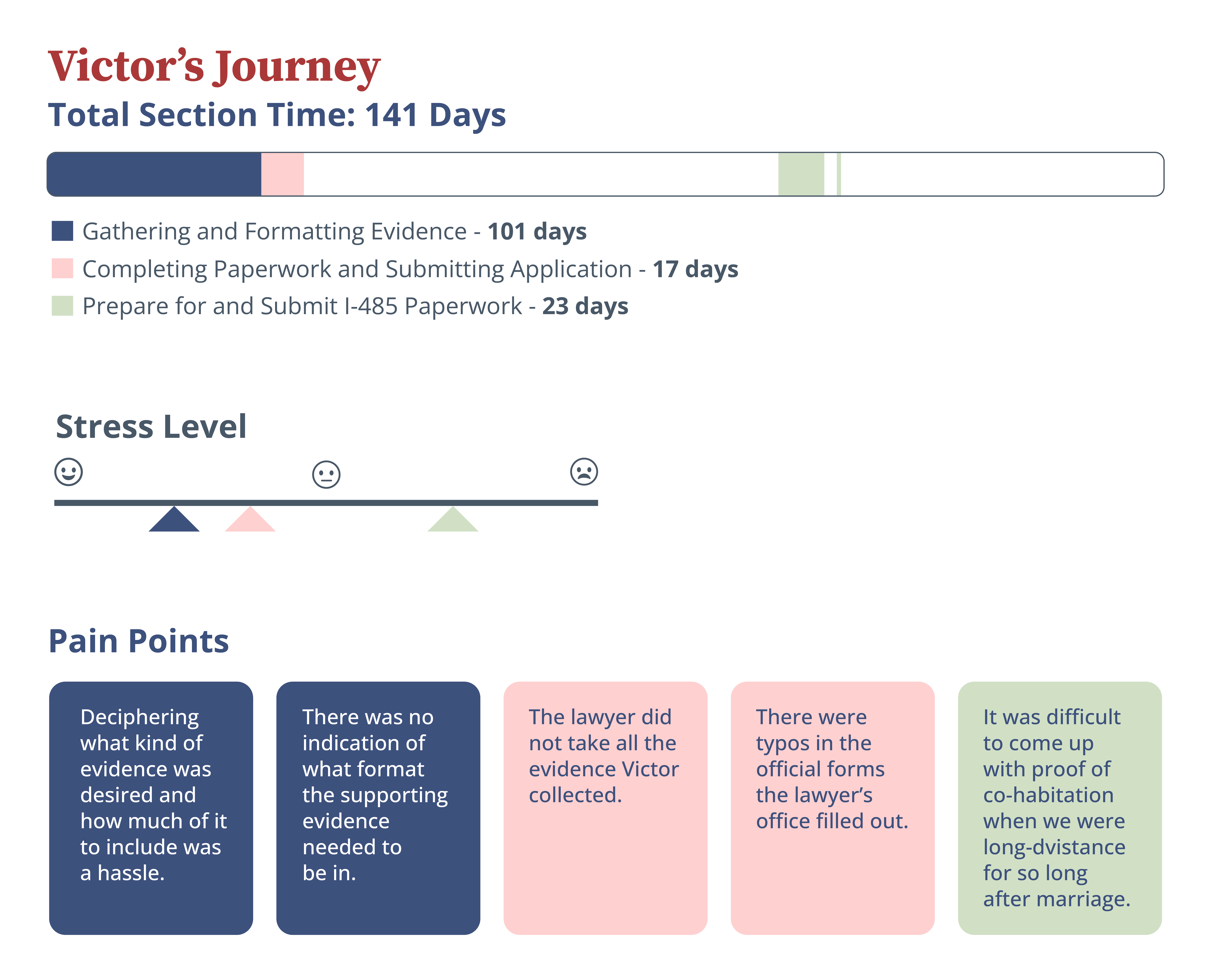
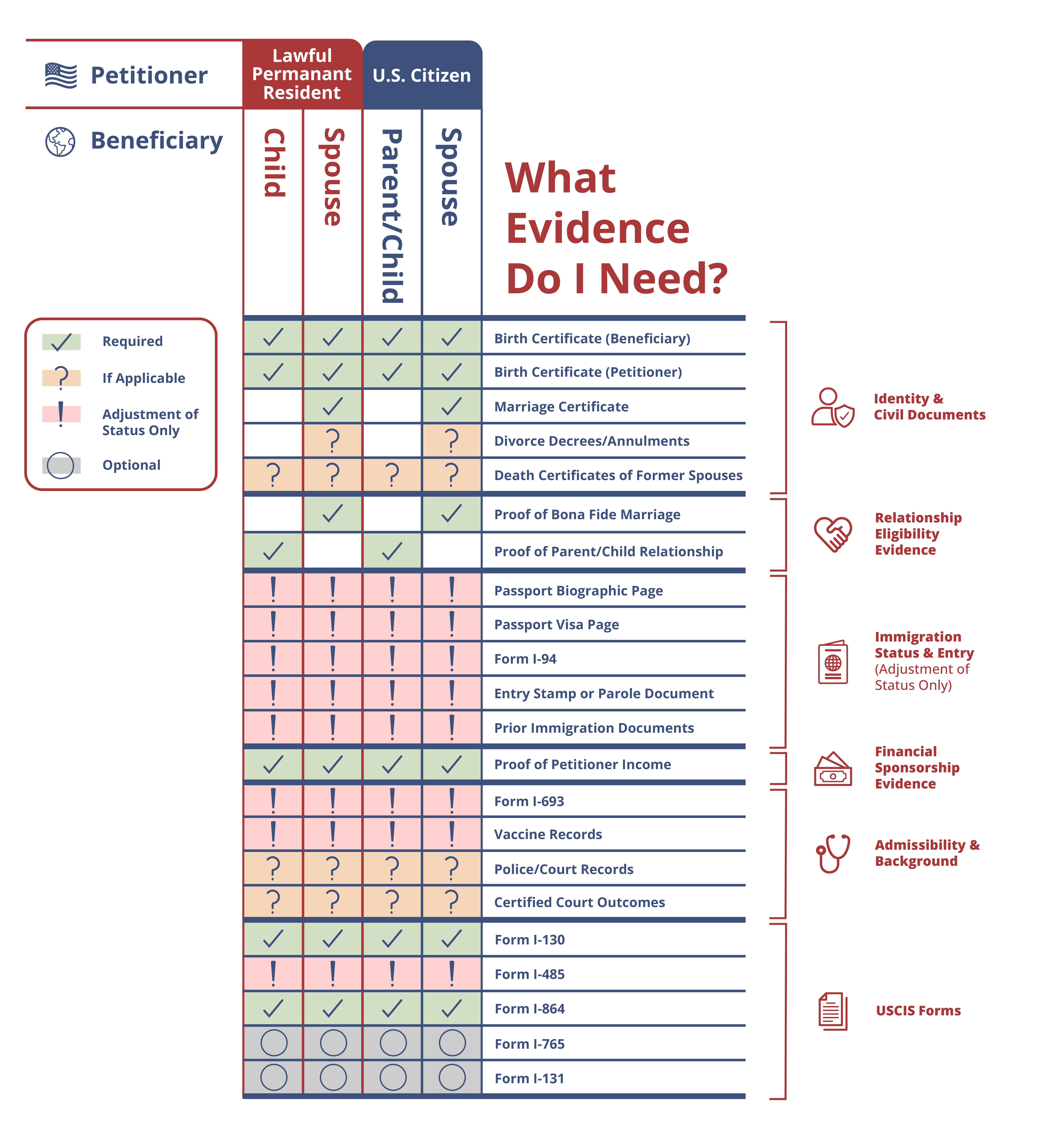
Once you have planned your route, you are ready to prepare your application. There are six broad evidence categories that USCIS will look for. You can think of these as lenses they will use to understand your case. They are:
Below, you will find a table that shows what you may need to submit for each category. It is meant to help you clarify what matters for your specific situation.
Now that you understand the big picture, this section will walk you through putting your evidence together.
Immigration forms and processes can be confusing, and each case is unique. If you become frustrated, confused, or uncertain at any point, please consult with a licensed immigration attorney or an accredited legal representative, as this guide is not to be used as legal advice.
You can find free or low-cost legal help here:
Get Your Documents Ready
Let's start with what documents you should have ready to fill out your forms. You will need things for both the Petitioner (The U.S. citizen or green card holder) and the Beneficiary (the immigrant).
For the Petitioner
U.S. citizen or green card holder
U.S. citizen or green card holder
- Proof of status (U.S. passport, birth certificate, naturalization certificate, or green card)
- Proof of relationship (marriage certificate, birth certificate of child, etc.)
- Proof of prior divorces *
- Tax records and W2
For the Beneficiary
Immigrant
Immigrant
- Passport biographic page
- Birth certificate (with certified English translation if in another language)
- Marriage certificate (if marriage-based)
- I-94 arrival/departure record (if in the U.S.)
- Visa used to enter the U.S. *
- Medical exam results (Also known as Form I-693, submitted with or after I-485)
- Prior immigration records *
* if it applies to you
The Forms
There are many USCIS forms with names that may get confusing. If you have trouble understanding them, you can use the information below to help.
Filed by the Petitioner
I-130 | Petition for Alien Relative
Formally requests to sponsor a family member for immigration.
I-864 | Affidavit of Support
Proves the petitioner can financially support the immigrant.
Filed by the Beneficiary
I-485 | Adjustment of Status
Requests a green card for someone already in the U.S.
I-693 | Report of Medical Examination and Vaccination Record
Filled out by the civil surgeon
Documents the results of the required immigration medical exam.
I-765 | Application for Work Authorization (Optional)
Requests permission to work while the case is pending.
I-131 | Application for Travel Document (Optional)
Requests permission to travel abroad while the case is pending.
Building Your Packet
Now let's go through each evidence category and prepare your packet to submit with your forms.
Organizing Your Packet
Congratulations! At this point, you should have everything you need for each evidence category. Let's move on to assembling and organizing the full packet.
Start With Structure
A strong packet usually follows a simple flow:
- Payment
- A short cover letter (optional but helpful)
- Completed forms
- Identity and civil documents
- Relationship evidence
- Financial sponsorship evidence
- Immigration history *
- Medical exam *
- Any additional supporting documents
* if it applies to you
The Cover Letter
A cover letter works like a guide for the immigration officer reviewing your case. It explains who is applying, what forms are included, and what documents are in the packet. The cover letter is not required, but it is a good idea to include one. It may help prevent delays.
If you would like to work off of a template, you can use the one linked below. Please be mindful as you use it, and be sure to customize everything so it matches your specific packet.
Cover Letter Template"We did a cover letter with a table of contents outlining our evidence. We also captioned all photos with who/where/when/etc."
Read the Thread"I suggest to have separate header page explaining what kinds of evidence it has. I had below header pages to organize the evidence. I submitted:
0. Evidence for Bonafide Marriage
- 1. Joint Financials
- 2. Joint Insurances
- 3. Join pictures and trips
- 4. Evidence for Common Residence
- 5. Affidavits from Friends and Family"
Planning on Mailing a Paper Packet?
- Use single-sided printing unless instructions say otherwise.
- Do not bind the packet in a way that makes it hard to separate.
- For example, choose binder clips instead of staples
- Place dividers between major sections.
"Take a look to the tips for filing on their website. If you want to label the documents with tabs, do so at the bottom of the page rather than on the side. According to the information on their website, this will make it easier for them to review. Also include the cover letter
https://www.uscis.gov/forms/filing-guidance/tips-for-filing-forms-by-mail"
Read the Thread"I need to send in i751 form. There is an option to do it online. Naturally I think it's the best since it's guaranteed to end up in their computers faster comparing to waiting on someone opening envelope, scanning it....e.t.c.
My only concern is that it is a new way of doing things and I do not want to be a guinea pig...
UPDATE: We did it online, easy and fast, in less than a week we got a letter about extension of the green card to 48 month. Process is working the same as if you file it through regular mail except there are numerous benefits of filing online. Save $50, get better visibility, get result faster... no cons, only benefits."
Read the ThreadIt is time to submit your application! Take a deep breath and take it one step at a time, making sure to read through everything carefully.
You can file:
- Online through a USCIS account (for eligible forms), or
- By mailing a paper packet to a USCIS lockbox
Step 1: Confirm your form can be filed online.
You can check hereStep 2: Create or log into your USCIS account.
Step 3: Complete the online form
- Answer each question carefully.
- Do not guess.
- Save often.
Step 4: Upload your evidence
- Use clear scans.
- Use simple file names. For example:
- I-130.pdf
- Marriage-Certificate.pdf
- Joint-Bank-Statements-2022-2023.pdf
- Upload documents in the correct section.
Step 5: Pay online.
At the end of the process, you will pay electronically using a debit card or credit card.
Step 6: Submit and save confirmation
- Download your receipt and keep a copy of everything you submitted.
Step 1: Confirm the correct mailing address
Check the official USCIS website using the buttons below for the correct address for your form and state.
Step 2: Complete the payment authorization form.
USCIS now only accepts electronic payments. They no longer accept paper checks or money orders. For mailed applications, you must include a payment authorization form for debit or credit card.
You have two payment options:
- Form G-1650 — Authorizes a direct ACH debit from a U.S. bank account (checking or savings).
- Form G-1450 — Authorizes payment by credit card, debit card, or prepaid card.
You must choose one payment method for your filing. You cannot mix both forms in the same application packet.
Here are things to keep in mind when filling out your payment form:
- Use the latest edition of the form from the USCIS website.
- Fill it out in black ink (or type it).
- The account must be from a U.S. bank.
- The account holder must sign by hand.
- Typed signatures are not accepted.
- If someone else is paying for you, they must complete and sign the form.
Important Payment Rules
- Each USCIS form requires its own payment authorization form.
- You cannot combine multiple filing fees on one payment form.
- You cannot mix debit and credit forms in the same filing.
- If splitting a fee between two cards, you must use the same form type and make sure the total equals the correct filing fee.
Step 3: Check your packet
Place the payment authorization form on top of your entire packet. Then, go through your packet and ensure that everything is there and accurate. If you need a refresher, you can go back through the Building Your Packet section.
Step 4: Make a full copy
Scan or photocopy everything before mailing.
Step 5: Mail with tracking
Use a mailing service with tracking and keep your receipt.
Step 6: Wait for your receipt notice
- If payment is approved, USCIS will issue a receipt notice.
- If the payment is declined, USCIS may reject the entire filing.
Notify Your Bank
Before mailing your packet:
- Contact your bank.
- Tell them you are making a payment to the U.S. Department of Homeland Security.
- Ask them to allow the transaction.
- If using a debit card, ask them to remove any "ACH debit block." Many applications are rejected because the bank declines the payment.